At the 7th EU–LAC Academic Summit in Portugal, our Founding President and EUPHE President Karl Wöber emphasized the importance of regulatory cooperation, academic recognition, and equal opportunities for public and private universities.
From October 21–23, 2026, higher education leaders, policymakers, and academic representatives gathered in Porto and Maia, Portugal, for the 7th European Union–Latin America and the Caribbean (EU–LAC) Academic Summit.
Representing the European Union of Private Higher Education (EUPHE) as its President, Univ.-Prof. Dr. Karl Wöber contributed to discussions on strengthening academic cooperation between the two regions and creating a more integrated international higher education landscape.
Breaking Down Barriers to International Education
A key focus of the summit was turning international cooperation ambitions into practical opportunities for universities, students, and researchers.
During his contribution, Karl Wöber highlighted the importance of transparent academic recognition procedures, compatible quality assurance standards, and fewer regulatory obstacles to international mobility.
"International academic cooperation can only reach its full potential when institutions and students experience fewer barriers and more opportunities. This requires political commitment, mutual trust and the willingness to make our higher education systems work together."
Wöber also emphasized that accredited private universities should have the same opportunities as public institutions to participate in international academic partnerships, student exchanges, joint degree programs, and research initiatives.
Advancing a More Connected Higher Education Landscape
The summit brought together representatives from Europe, Latin America, and the Caribbean to explore the development of a common Higher Education, Science, Technology and Innovation Area.
Discussions focused on improving the recognition of qualifications, strengthening cooperation between accreditation bodies, supporting student and faculty mobility, and ensuring equal participation for recognized higher education institutions.
One of the summit's central initiatives was the development of the Maia Declaration, aimed at advancing academic integration and shaping future cooperation between the regions.
For Modul University, whose international academic community and global partnerships are central to its educational approach, these discussions reflect the importance of creating accessible opportunities for students and researchers across borders.
Through his leadership at EUPHE, Karl Wöber continues to contribute to international higher education policy discussions and advocate for a more connected, inclusive, and internationally collaborative academic environment.
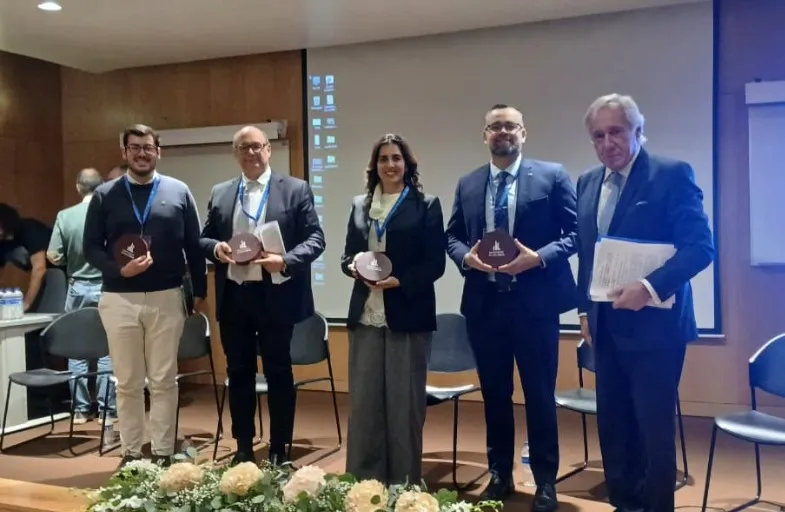
Participants at the 7th EU–LAC Academic Summit in Portugal. From left to right: Pedro Miguel Almeida, President of Erasmus Student Network Portugal; Karl Wöber, President of EUPHE and our Founding President; Yadira Ornelas, Director of the Department of Design at Tecnológico de Monterrey, Mexico; and Jorge Pablo Barth Arroyo, Vice-Rector for Teaching at Universidad Nacional, Costa Rica. The session was chaired by Professor João Redondo, President of the General Assembly of APESP and President of Fundação Minerva.