Accreditation & Quality Management

Accreditation & Quality Management

AT A GLANCE

Modul University Vienna relies upon a diverse set of policies, organizational bodies, and reporting mechanisms to ensure quality in its various operations. This framework has been developed as a product of MU’s commitment to quality assurance and continuous institutional improvement.

The quality management strategy currently in place at MU serves to satisfy several broad objectives:

  • Ensuring the university’s academic offerings, courses, and study programs are of the highest possible quality

  • Ensuring that research is conducted according to the highest ethical and academic standards

  • Encouraging continual improvement to all areas of the university’s operations through cycles of self-evaluation and subsequent improvement

  • Encouraging broad participation by various stakeholders within the university towards continual building and maintenance of a quality-focused culture

  • Demonstrating a commitment to the quality assurance frameworks set out in the European Standards and Guidelines, the Agency for Quality Assurance and Accreditation Austria, and other accrediting agencies with which the university is affiliated.

External quality assurance is provided by AQ Austria. Indeed, after the initial accreditation in 2007, MU has had to renew its accreditation every six years, while submitting accreditation proposals for newly developed study programs. Moreover, MU has to provide the AQ Austria with an annual report to report on the changes that happened at the university, especially in terms of quality management. Finally, MU also has a Quality Management Handbook, which supports faculty and staff to implement all quality management processes.

ACCREDITATIONS
Agency for Quality Assurance and Accreditation Austria

All programs are accredited by the Agency for Quality Assurance and Accreditation Austria (AQ Austria), a member of the European Association for Quality Assurance in Higher Education (ENQA), the Central and Eastern European Network of Quality Assurance Agencies in Higher Education (CEENQA), the International Network for Quality Assurance Agencies in Higher Education (INQAAHE), the European Quality Assurance Register for Higher Education (EQUAR), the European Association of Institutions in Higher Education (EURASHE), and the European University Association (EUA).

The reports, the evaluations of the reviewers and AQ Austria's decision on the accreditation and other documents regarding the process have to be published (German only):

2021:

2017:

Bachelor of Business Administration in Tourism and Hospitality Management, Bachelor of Science in International Management, Master of Science in Sustainable Development and Management, Master of Business Administration at the Modul University Dubai:

Bachelor of Business Administration in Tourism and Hospitality Management at the Modul School of Tourism and Hospitality Management Nanjing:

2016:

Master of Science in Management:

2014:

Re-Accreditation of the University:

United Nations World Tourism Organisation

Since 2012, the tourism-related programs at Modul University Vienna have been accredited by the UN Tourism Themis foundation's TedQual certification system.

UN Tourism.TedQual

Quality management

Quality Management System


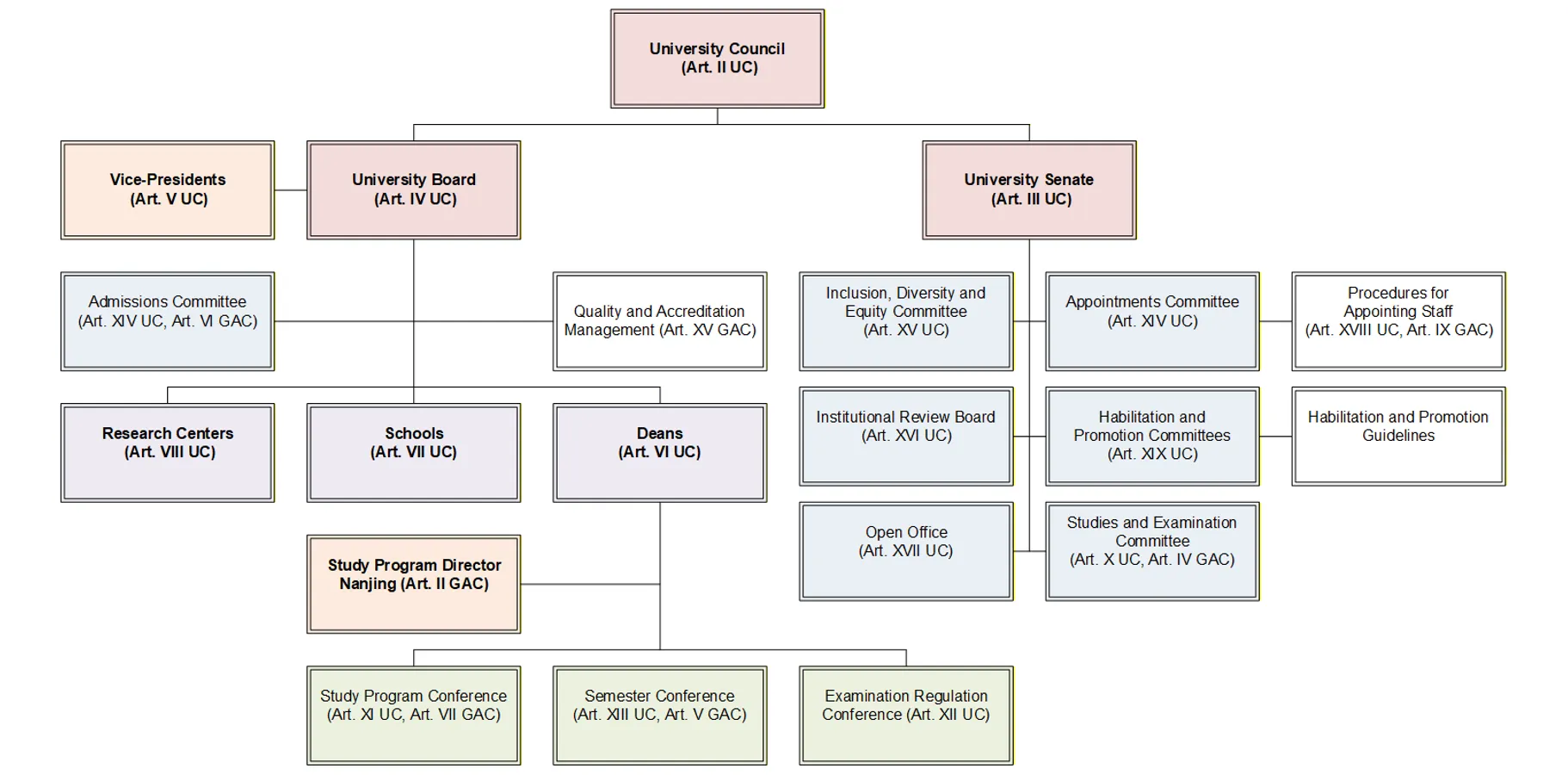
The Quality Management System (QMS) at Modul University Vienna consists of different components, displayed in Figure 1, which are also used at the Global Campus in Nanjing.
Quality management is strategically overseen by the University Board and operationally coordinated by the Quality and Accreditation Manager, who reports to the University Board, manages all evaluation instruments, produces quality reports, and supports accreditation procedures. On the Nanjing campus, the Program Director leads QMS implementation with support from the local Quality Management Officer, in coordination with the Quality and Accreditation Manager in Vienna.
The QMS operates through a multi-body governance architecture that distributes responsibilities across governing bodies - the University Council, the University Board, and the University Senate - and a range of operational bodies, including Schools, Deans, Research Centers, the Studies and Examinations Committee, Degree Study Program Conferences, Semester Conferences, Appointments and Promotion Committees, Industry Advisory Boards, and student representatives. The Institutional Review Board, the Inclusion, Diversity, and Equity Committee, the Admissions Committees, and the Open Office also form part of this institutional quality framework.
The QMS is formally documented in the Quality Management Handbook, which is publicly accessible through the University's Academic Administration System (AAS).


The university's quality management strategy requires input from a range of stakeholders. To facilitate this, the University relies on multiple governance and advisory bodies. These groups and their quality management functions are described below:
The University Council
The University Council is the University's strategic supervisory body. It approves the University's Development Plan, which sets the institution's strategic and quality-related objectives, and is responsible for appointing and overseeing the University Board. Through this role, the University Council exercises a strategic-level quality management function, ensuring that the University's direction remains aligned with its long-term academic and quality objectives.
The University Board
The University Board consists of the President, the Executive Vice-President, and the University Director, and meets on a regular basis to provide direction on matters of academic and operational importance. The University Board is the University's executive body and holds strategic and executive responsibility for quality management: it receives all quality-relevant reporting and translates findings into institutional decisions, defining and directing the university's quality management policies and priorities.
The University Senate
The University Senate is the University's central body of academic self-administration and the principal forum for discussing matters of academic quality and institutional effectiveness. Its responsibilities relevant to quality management include passing resolutions on academic regulations and study program amendments, adopting guidelines for professorial appointment and promotion, and electing faculty and administrative staff representatives to bodies such as the Studies and Examinations Committee and the Inclusion, Diversity and Equity Committee. The Senate also evaluates candidates for the University's academic leadership positions and proposes rankings to the University Council.
The Degree Study Program Conference
The Degree Study Program Conference is the forum, convened by each School's Dean at least once per semester, for discussing and proposing academic regulations related to degree study programs. It serves as a platform for information and quality management for its School. At the Nanjing campus, the Study Program Conference performs a similar quality management role and is attended by the campus's local academic representatives.
The Examination Regulation Conference
The Examination Regulation Conference is responsible for proposing changes to the Examination Regulations and Student Code of Conduct. It serves as a platform for information and quality management, safeguarding the rights and duties of students across all degree study programs. Its members include all Deans, a representative of the Studies and Examinations Committee, the head of quality management, a representative of the Academic Office, and two student representatives; the chair is elected by the University Senate from among the Deans.
The Semester Conference
The Semester Conference is convened at the end of each semester to decide on a student's termination of enrollment due to academic reasons (to be executed by the University Board), subsequent readmission, and examination reattempts. Its members include the Dean, the teaching staff of the respective study program, one member of the Academic Office, and two student representatives (both with an advisory vote). At the Nanjing campus, members include the Program Director, all Program Area Directors, the teaching staff of the respective study program, the Quality Manager, the Academic Officer, and two student representatives (advisory vote).
The Studies and Examinations Committee
The Studies and Examinations Committee ensures compliance with good scientific and artistic practice and ethical standards across the University's academic activities, including addressing cases of academic misconduct, and reports at least once per semester to the University Board on the outcomes of such cases. The Committee also serves as the appeals body for decisions taken under the Examination Regulations and Student Code of Conduct. An equivalent committee exists at the Nanjing campus.
Industry Advisory Boards
To support the mid- and long-term planning of its study programs and research activities, MU maintains Industry Advisory Boards for the School of Tourism and Service Management and the School of Sustainability, Governance, and Methods. Distinguished industry representatives advise on market relevance and curricular alignment, and the results of these meetings are provided to the University Board for consideration in the university's quality management initiatives. Additional Industry Advisory Boards are planned for the Schools of International Management, Applied Data Science, and International Relations.
The Inclusion, Diversity and Equity Committee (IDEC)
The Inclusion, Diversity and Equity Committee advises on matters of diversity, gender equality, and inclusion across the University. It proposes an Affirmative Action Plan to the University Senate and monitors its compliance once approved, and reports a summary of its activities once per academic year to the University Board and University Senate.
The Institutional Review Board (IRB)
The Institutional Review Board is the University's independent research ethics committee. It reviews and approves the data collection procedures and instruments used in research conducted at Modul University Vienna, ensuring that research involving human subjects complies with good scientific practice and applicable ethical standards.

Accreditations by country

saudi arabia

Listed as a recognized university by the Saudi Ministry of Higher Education. Listed as a recommended university for the King Abdullah Scholarships Program.

www.mohe.gov.sa/en

Oman

MODUL University is listed by the Omani Ministry of Higher Education as a recognized university.

www.mohe.gov.om

China

Modul University is included on the list of recognized universities of the Ministry of Education of the Chinese People's Republic.

www.moe.gov.cn

taiwan

Modul University Vienna is included on the list of recognized universities of the Taiwanese Ministry of Education.

english.moe.gov.tw

Talk To Us

If you have questions about studying at MU, the application process or any other topic related to the university please contact us

Get In Touch
Start your application process here

Have any questions about studying at MU or the application process? Connect with our Student Recruitment Team and they will assist you every step of the way.  

Apply Now